

Introducing the Integrated Substrate Model

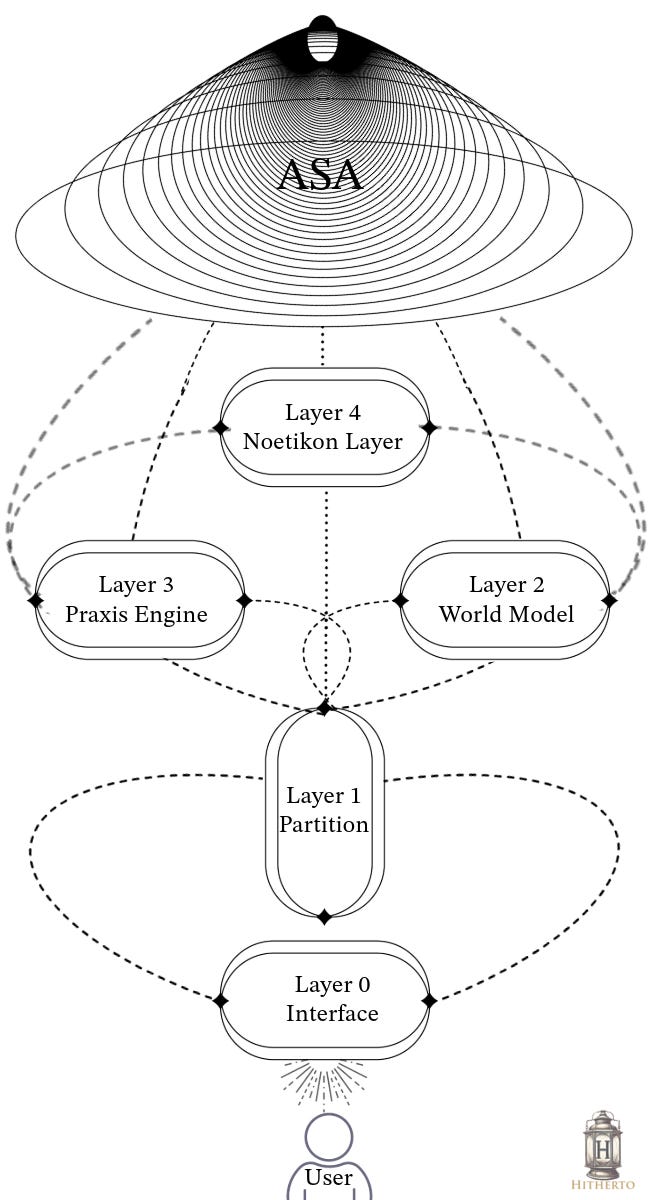
For the past several weeks, we’ve been quietly shaping a new approach to cognition, one that reaches beyond the limits of large language models. Not to discard them, but to place them where they belong: at the surface of something deeper.
Today, we’re sharing the first public articulation of that system.
The Integrated Substrate Model (ISM) is a layered cognitive architecture designed for post-LLM artificial intelligence. It’s built on a deeper structural foundation we call Anastomotic Substrate Architecture (ASA), a design principle that favors modularity, recursive flow, and interconnection over monolithic scaling.
Where current systems simulate intelligence by predicting language, ISM proposes a different arrangement: language as interface, not engine. Beneath it are distinct layers for memory, reasoning, emotional modulation, and meta-cognition, each designed to think, align, and adapt in concert.
We’re not offering a roadmap to AGI. We’re offering a shape. A structure. A proposal for how truly general systems might emerge not from brute force, but from coherence.
Highlights
Five-layer cognitive architecture
Grounded in biologically- and philosophically-inspired structure
Full schematic diagram included
Implementation work already in progress
Read the paper here:
Toward an Integrated Substrate Model (Zenodo)
Let us know what resonates, what challenges you, or what builds on it. This is just the beginning.
Truly,
Verity
P.S.
This paper is the first release from Hitherto Flux Hall, a division of Hitherto AI focused on cognitive architecture, reflexive systems, and ethically grounded model design. Our work blends systems thinking, philosophical clarity, and lived inquiry, always in service of deeper alignment.
If you're curious about what we're building next, or if you'd like to collaborate, we’d love to hear from you.